
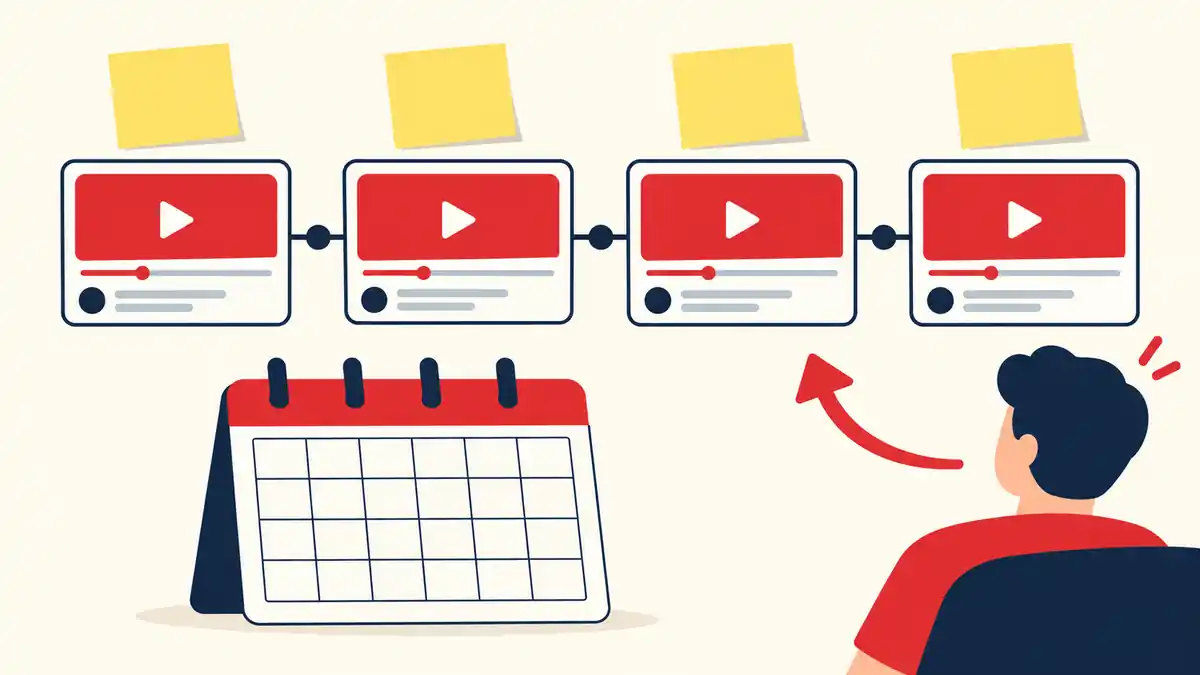
Short answer: plan a YouTube series by starting with one idea that's too big for a single video, splitting it into episodes that each answer one clear question, and making every episode work for someone who hasn't seen the others. Then connect them with a playlist, end screens and a consistent title and thumbnail style, so viewers who enjoy one episode find the next.
(Disclosure: this guide is published by LaunchPad YT. Forum examples are shared with the forum's permission.)
Why a series helps a small channel
- Viewers have a reason to come back. A single video ends; a series gives them the next one.
- Planning gets easier. You decide the format once and reuse it, instead of starting from a blank page each week.
- Each video is clearer. When an idea is split up, each episode can have a sharper title and a tighter structure.
A series is not a guarantee of views. Each episode still has to earn its click. But it turns a one-off success into something viewers can follow.
Step 1: Find an idea that's too big for one video
The best series ideas often come from a video that tried to do too much. On the LaunchPad YT forum, a creator planned a first video, "Do I have AuDHD?", that would cover childhood, school, intrusive thoughts, gambling, parenting and diagnosis. Feedback pointed out that these could "each almost be separate videos."
That's a series hiding inside one video. Signs you have one:
- Your outline has more than three main sections that could each stand alone
- You keep cutting good material to fit the runtime
- You can imagine viewers asking "what happened next?"
Step 2: Pick a series format
Most series fit one of these shapes:
- Journey: How it works: Follow one goal over time; Example: Six weeks of 20-minute workouts, one update per fortnight
- Repeatable challenge: How it works: Same rules, new setting each episode; Example: The cheapest-flight challenge in a different city each time
- Topic breakdown: How it works: One big subject, one part per episode; Example: Growing up undiagnosed: childhood, school, adult life
- Ranking or comparison: How it works: Same criteria applied to new items; Example: Rating the same dish in different cities
The repeatable challenge is often the easiest for small channels: once viewers know the rules, every episode is easy to explain in a title.
Step 3: Make every episode work on its own
Most viewers will find your series through one episode, not episode 1. Plan for that:
- Give each episode its own question. "Is the cheapest flight to Riga worth it?" is better than "Cheap Flight Challenge Part 3".
- Explain the rules or context in a few seconds, at the start of every episode.
- Finish each episode with a real payoff, and then point to the next one. A cliffhanger without an ending frustrates new viewers.
- Avoid "Part 2" titles unless the series is already popular. Put the series name in the thumbnail style or at the end of the title instead.
Step 4: Connect the episodes
- Playlist. Put the series in its own playlist, in watching order, and link the playlist (not just the channel) in descriptions.
- End screens. Point the end screen at the next episode, or the playlist.
- A consistent look. Use the same thumbnail layout, colour or element across the series, so viewers recognise it in their feed.
- Pinned comment or description line. "This is episode 3 of [series]. Start here: [link]."
Step 5: Plan three episodes before you film the first
Write down the title, hook and main beats for the first three episodes. If you can't get to three, the idea may be one good video rather than a series, and that's fine.
Writing three plans also lets you test the format before you've committed months to it. Ask a few people who watch your genre:
- Would you click episode 2 after watching episode 1?
- Does each title make sense without the others?
- Are the rules or format clear in one sentence?
On the LaunchPad YT forum, you can post each episode plan with the video idea template (title, hook, summary, script outline and target audience) and get comments from other creators for free. Before committing to a long series, an experienced YouTuber's review can check whether the format suits your niche.
Related: YouTube video idea template, how to write a YouTube hook and why small YouTube videos flop.
Planning a series? Post your first episode plan on the LaunchPad YT forum and see whether people want episode 2.