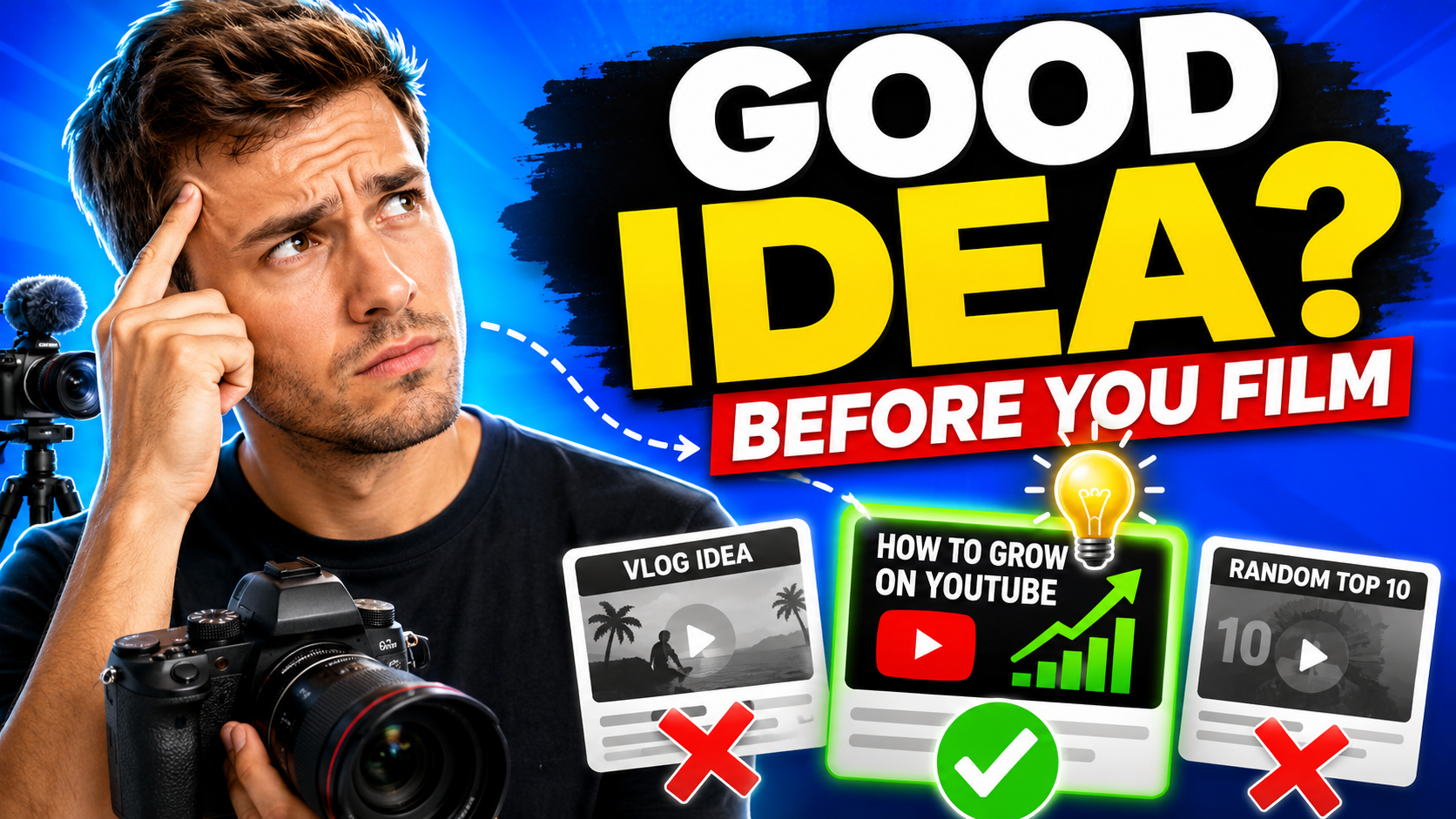
One of the most expensive mistakes on YouTube happens before you press record.
You spend hours researching, filming and editing a video. You design the thumbnail, upload it and wait.
Then it gets 83 views.
Most creators respond by asking what went wrong with the thumbnail, the title or the algorithm.
But sometimes the problem started much earlier:
The video idea simply wasn't strong enough.
A beautifully edited average idea is still an average idea.
So before you spend 10 hours making your next video, here are seven questions you can use to work out whether the idea is actually worth filming.
1. Can You Explain the Video in One Sentence?
Start with the simplest test.
Describe your video in one sentence.
Not:
I'm making a video about bubble tea and comparing different types and talking about whether expensive ones are worth it.
Try:
I'm comparing a £1 bubble tea with a £100 bubble tea to see whether you can actually taste the difference.
The second version immediately gives us:
- a subject
- a contrast
- a question
- a reason to keep watching
If you need a paragraph to explain why somebody should care about your video, the idea probably isn't clear enough yet.
A strong YouTube idea usually has a simple promise.
By the end of this video, the viewer will know, see or experience something they didn't know before.
2. Who Is This Video Actually For?
"People who like YouTube" isn't an audience.
Neither is "everyone."
Imagine YouTube had to choose one person to recommend your video to.
Who would that person be?
For example:
Weak:
People interested in fitness.
Better:
People who have just started going to the gym and don't know which exercises to do.
Even better:
Beginners who want to build muscle but can only train three times a week.
The more clearly you understand the viewer, the easier almost every other decision becomes.
You know what language to use.
You know what problem to solve.
You know what title might attract them.
And most importantly, you can ask:
Would this particular person genuinely want to watch this?
3. Is There a Reason to Click This Video Instead of Another One?
This is where many perfectly reasonable ideas fail.
Imagine somebody searches:
"How to grow on YouTube"
They might see:
- How to Grow on YouTube in 2026
- 10 Tips to Grow Your YouTube Channel
- How I Got My First 1,000 Subscribers
- I Started a New YouTube Channel and Tried to Reach 1,000 Subscribers in 30 Days
Which one feels most interesting?
The first two might contain excellent information.
But they're generic.
The last two contain something more specific: a story or proof.
You don't necessarily need a completely original subject.
You need an interesting angle.
Instead of:
How to Save Money
try:
I Tried Living on £10 a Day for a Week
Instead of:
Best Cheap Cameras
try:
I Tested 5 Cameras Under £100 — Only One Was Actually Good
Instead of:
Learning Spanish
try:
I Tried Learning Spanish for 100 Hours
The topic can be familiar.
The presentation shouldn't feel interchangeable with another 100 videos.
4. Can You Imagine the Title and Thumbnail Before Filming?
You don't need to finalise them before filming.
But you should be able to imagine them.
This is one of the best tests of whether an idea has enough tension.
Suppose your concept is:
Today I'm going to visit several restaurants in London.
What is the thumbnail?
What is the title?
It's difficult because there isn't much of a story yet.
Now change the idea to:
I'm Eating at London's Worst-Rated Restaurant
You can already imagine the package.
The thumbnail might show you looking worried beside a plate of food and a one-star rating.
The title explains the challenge.
The idea itself generates the packaging.
That's a good sign.
If you're struggling to create an interesting title before filming, don't assume you'll magically discover one after you've spent two days making the video.
Fix the concept first.
5. What Makes Someone Want to See the Ending?
Clicks matter.
But getting the click is only half the job.
Once someone starts watching, you need a reason for them to continue.
Ask:
What question is still unanswered 30 seconds into the video?
Consider:
I Bought the Cheapest Car on Facebook Marketplace
Immediately we want to know:
Does it work?
What's wrong with it?
Can it actually drive?
Was it a complete disaster?
The concept naturally creates unanswered questions.
Compare that with:
My Thoughts on Buying Used Cars
It might contain equally useful information.
But there's much less reason to keep watching.
Strong video ideas often contain what you might call an information gap.
The viewer knows enough to become curious, but not enough to know the answer.
Comparison videos do this naturally.
Challenges do it naturally.
Experiments do it naturally.
Transformations do it naturally.
Good educational videos can do it too:
I Analysed 1,000 Successful YouTube Videos — Here's What They Had in Common
You want to discover the result.
6. Is the Idea Interesting, or Just the Production?
There's a dangerous trap creators fall into.
They start getting excited about:
- the camera
- the editing
- the location
- the graphics
- the drone shots
- the transitions
But none of those things are the idea.
Try mentally removing all the production quality.
Imagine the same concept filmed on a phone.
Would you still want to know what happens?
If yes, that's a very good sign.
If not, you might be trying to use production to rescue a weak concept.
YouTube viewers rarely click because a video was difficult to make.
They click because the result looks interesting.
7. Would Someone Else Choose This Idea?
This is probably the most useful test — and one creators don't use enough.
Before filming, show several ideas to other people.
Don't ask:
Is this a good idea?
People are polite.
They'll probably say yes.
Instead, give them choices.
For example:
Which one would you watch?
A. I Tried Every Bubble Tea Shop in London
B. £1 vs £100 Bubble Tea
C. How Bubble Tea Is Made
D. Britain's Most Expensive Bubble Tea
Now they have to make a decision.
Even better, show the ideas to people who understand YouTube or actually belong to your intended audience.
That's one of the reasons we built LaunchPadYT.
Instead of spending days producing a video and discovering afterwards that nobody wanted it, you can post your concept, title, hook and target audience on LaunchPadYT and get feedback from other creators before you film it.
You're effectively testing the idea while changing it is still cheap.
A Simple YouTube Idea Test
Before committing to a video, score it from 1–5 on these six things:
Clarity
Can someone understand the idea immediately?
Audience
Do you know exactly who should watch it?
Curiosity
Does the idea create a question people want answered?
Differentiation
Why choose this video instead of similar ones?
Packaging
Can you already imagine a strong title and thumbnail?
Payoff
Is there something worth staying until the end to see?
You don't need a perfect 30/30.
But if your idea scores 2/5 across most categories, improving the concept will probably produce a bigger return than improving your editing.
Don't Ask "Is This a Good Video?"
Ask a slightly different question:
Is this the best idea I could make next?
That's an important distinction.
You may have five perfectly acceptable ideas.
But perhaps one of them has twice the potential of the others.
If every video costs you a day, a week or even a month to produce, choosing between those ideas matters enormously.
Professional creators don't just become better at making videos.
Over time, they become better at deciding which videos deserve to be made at all.
And that's a skill you can practise before you ever turn the camera on.
Before filming your next idea, put it in front of other creators and see which concept they would actually choose.
Test your next YouTube idea on LaunchPadYT →
Because the cheapest time to discover that an idea doesn't work is before you film it.