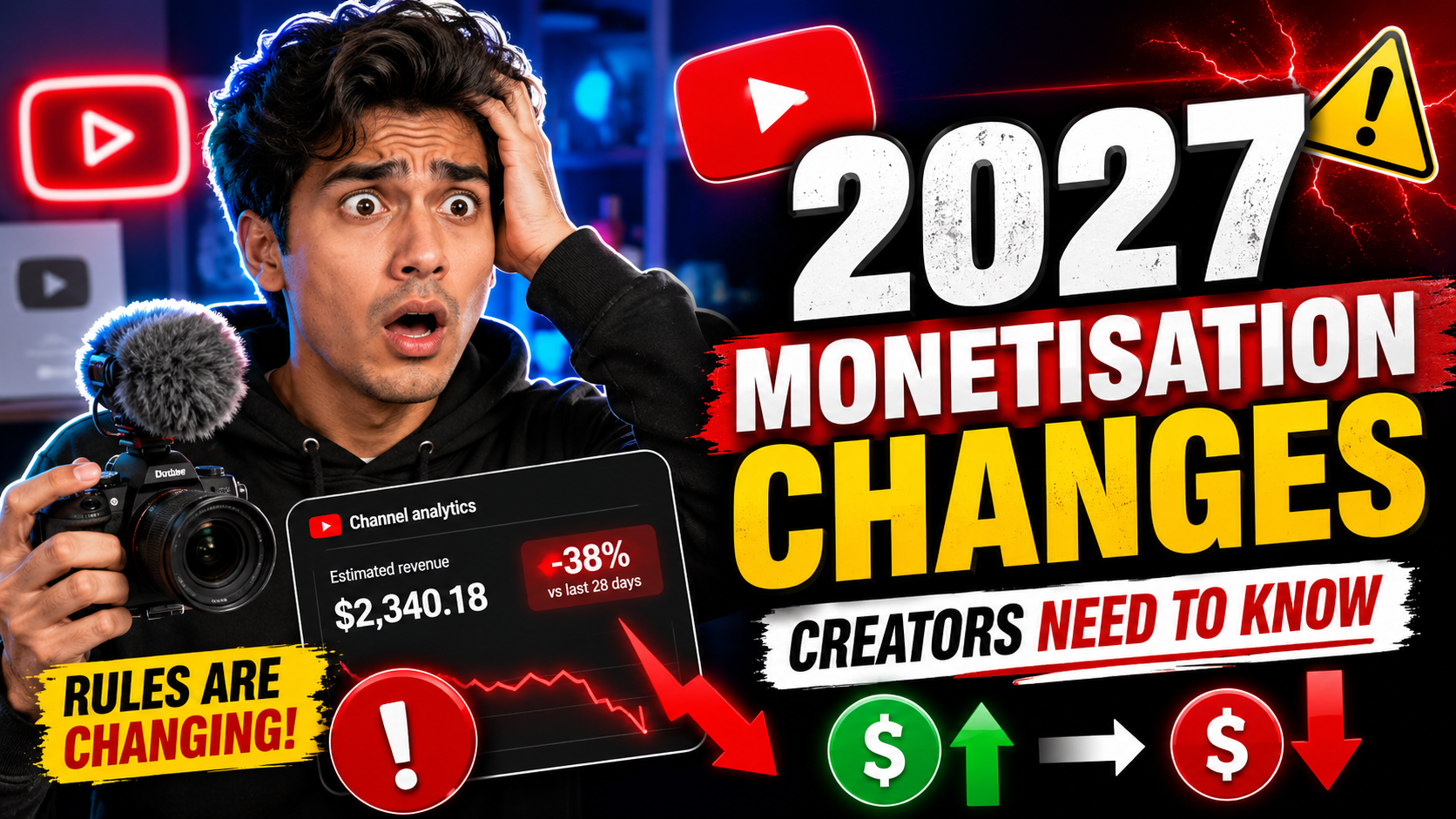
YouTube has announced some of the biggest changes to its Partner Programme in years — and if you're a smaller creator trying to reach monetisation, you need to know about them.
The changes were announced on 10 August 2026 and will take effect from 1 February 2027.
The headline is simple:
It is about to become significantly harder for new creators to qualify for YouTube ad revenue.
But that's not the only change. YouTube is also changing how Shorts creators earn money, introducing new activity requirements and expanding Premium Lite revenue.
Here is what actually matters.
The Monetisation Threshold Is Doubling
Currently, creators aiming for full advertising revenue generally need:
- 1,000 subscribers
- 4,000 eligible public watch hours over 12 months
or
- 10 million eligible Shorts views over 90 days.
From 1 February 2027, new creators applying for ad and YouTube Premium revenue sharing will instead need:
- 1,000 subscribers
- 8,000 qualified watch hours within 365 days
or:
- 20 million qualified Shorts views within 90 days
YouTube has therefore effectively doubled the viewing requirement for new channels trying to unlock advertising revenue.
The important part: if you're already in the YouTube Partner Programme, YouTube says this new entry threshold will not remove you from YPP.
For creators who are close to 4,000 hours today, that makes the next few months particularly important.
If you can qualify before the February deadline, you could avoid having to reach the new 8,000-hour requirement.
The Lower 500 Subscriber Level Is Staying
There is some good news.
YouTube isn't removing its lower entry point into YPP.
Creators can still unlock features such as fan funding and YouTube Shopping once they reach:
- 500 subscribers
- 3,000 qualified watch hours in the previous year
or:
- 3 million qualified Shorts views over 90 days.
So the pathway into YouTube's wider monetisation ecosystem still begins relatively early.
The change specifically affects the higher threshold needed for advertising and Premium revenue sharing.
Shorts Creators Have a Bigger Problem
The biggest change may actually be for channels that depend heavily on YouTube Shorts.
From February 2027, creators will need to maintain 10 million qualified Shorts views over the previous 90 days to receive revenue from the Shorts Creator Pool.
Drop below that level and you don't get kicked out of YPP.
You can still monetise eligible long-form videos.
But your Shorts revenue sharing pauses until your channel gets back above the 10 million-view threshold.
That's a major distinction.
Previously, getting into YPP could feel like crossing a finish line.
For Shorts creators, monetisation is increasingly becoming something you have to continuously maintain.
What Does YouTube Mean by a "Qualified" View?
This is another detail creators shouldn't ignore.
YouTube specifically uses the term qualified watch hours and qualified Shorts views.
For long-form content, qualifying watch hours generally need to come from public long-form videos, podcasts or archived livestreams.
Watch time from things such as private videos, unlisted videos, deleted videos, Shorts or videos watched through advertising does not count.
For Shorts, YouTube says the viewer needs to actually continue watching beyond the initial seconds. Loops don't create additional qualified views either.
So seeing 20 million total views somewhere inside Analytics does not automatically mean you have 20 million views that count towards YPP eligibility.
Existing Channels Also Need to Stay Active
Being inside YPP doesn't mean you can abandon your channel indefinitely.
From February 2027, YouTube says a channel will be considered active if it achieves at least one of the following:
- 1,000 qualified watch hours within the previous 365 days
- 1 million qualified Shorts views within 90 days
- Two long-form uploads or five Shorts every 90 days
Channels falling below the requirements will have a 90-day period to restore their active status.
For most regularly active YouTubers this shouldn't be difficult.
But it sends a clear message about the direction YouTube is moving in
YouTube wants active creators, not dormant monetised channels.
There Is Some Good News: Premium Lite
Not every change is designed to raise the bar.
YouTube is expanding Premium Lite to every country where YouTube Premium is offered.
YouTube says Premium Lite will have its own creator revenue pool representing 60% of net subscription revenue, while creators continue receiving their share based on viewing.
YouTube also says that, based on its 2026 performance, creators earn more on average from a Premium user than when that same viewer watches advertising-supported YouTube.
That potentially gives creators another growing source of revenue outside traditional advertising.
Why Is YouTube Doing This?
YouTube says the platform now receives more than 200 billion Shorts views every day, while viewers watch more than one billion hours of YouTube on televisions daily.
As YouTube becomes larger, getting 4,000 hours of watch time arguably doesn't represent the same level of channel traction that it did when the threshold was introduced years ago.
YouTube says the changes are intended to reward active creators while allowing it to invest in new earning opportunities such as Shopping bonuses, brand-deal incentives and rewards for creators who start or grow trends.
But from the perspective of a new creator, the practical result is unavoidable:
the road to advertising monetisation is becoming harder.
What Should Smaller Creators Do Now?
If you're currently building towards monetisation, don't panic — but don't ignore the deadline either.
If you're anywhere near 1,000 subscribers and 4,000 watch hours, the next five months are valuable.
Rather than simply uploading more videos, focus on making fewer videos with a much higher chance of performing.
A channel producing 50 videos that each generate 100 views is going to struggle.
A channel learning how to consistently identify topics its audience wants, package those ideas with strong titles and thumbnails and hold viewers' attention has a much better chance of reaching these new thresholds.
And this is arguably the bigger lesson from YouTube's announcement.
The platform is gradually raising the value of quality, consistency and genuine audience demand.
Getting a video published isn't the difficult part anymore.
Getting people to choose it — and continue watching it — is.
The LaunchPad YT Take
For aspiring YouTubers, monetisation shouldn't be the first target.
Building a repeatable system for creating videos people actually want to watch should be.
Monetisation follows audience.
If YouTube is doubling the number of watch hours required, then testing your ideas before spending days producing them becomes even more important.
Ask yourself before your next upload:
Who is this video for?
Why would they click it?
What makes the idea different from everything else in their feed?
And would you personally watch past the first 30 seconds?
The monetisation target may be moving.
But the fundamentals of growing a YouTube channel haven't changed.
Create better ideas. Package them better. Learn from your audience.
And make every upload count.